Showing posts with label politics. Show all posts
Showing posts with label politics. Show all posts
Tuesday, 10 December 2013
MP Mike Thornton - The Big Interview
This is the third in the series of "The Big Interview", this time with Eastleigh MP Mike Thornton. I am a lot happier with the production of this interview, which is miles ahead of the previous Big Interviews. I feel that it looks much more professional and is in a very natural setting.
The main points I focused on throughout the interview were;
The IPSA announced 11% pay rise for MP's
Immigration - Romania and Bulgaria being granted free ability to enter the country on 1st January 2014
Prime Ministers Questions - is it appropriate how MP's are conducting themselves?
Eastleigh MP Mike Thornton has stated that he will be rejecting an 11% pay rise until his Eastleigh constituents start receiving higher pay themselves.
The Independent Parliamentary Standards Authority has announced plans to increase MP's pay by £7,600 making their annual pay £74,000 as from the 2015 general election.
Mike Thornton stated that he will donate any additional pay above 1% to the Mayors charities for the benefit of his Eastleigh constituents.

Tuesday, 12 November 2013
WINOL Week 6 - Rowenna Davis Interview
The interview has collected a large number of views, a big reason for this is that Rowenna Davis tweeted the link to the video on her Twitter, which has over 15,000 followers.

On the day of the interview I also tweeted Conservative Royston Smith, who will most likely be Rowenna Davis' biggest competitor in the 2015 General Election. He responded well, so I am currently working on getting him to come in for my next Big Interview.

I am also working on increasing the viewership, on both my interview with Rowenna Davis and Diane James, by posting links to the videos on relevant political forums and Twitter pages.

I was very pleased by the content of the interview, however i felt that the production side of it lets it down. The lighting is far too spotlighted and gives off quite an intense feel. This is purely down to the fact that this style of interview is new for us, so I will be working closely with the production team to try and get it right for the next interview.
For my text story for the WINOL website I chose to focus on three main topics that were brought up during the interview:
In an exclusive WINOL interview, Labour MP candidate Rowenna Davis said that she was “honoured and excited” to have been chosen to replace Southampton Itchen MP John Denham in the 2015 General Election.
When questioned on her Conservative competitor Royston Smith, she said: “I don’t think that this man can govern”, and added that: “he is someone that I will respect and take very seriously, but I do not fear him”.
Davis also said that despite her ties with Portsmouth, if there was a football match between Portsmouth and Southampton, she would “absolutely be wearing Southampton colours”.
The former journalist said that she agreed there needed to be some form of press regulation to prevent the “cartel of media giants” and stop the likelihood of a monopoly in the industry. But she disagreed with party leader Ed Milliband, who has supported the Royal Charter, saying that “the freedom of press is paramount,” adding: “people should be allowed to have their say without being fearful of the state”.
Sunday, 3 November 2013
WINOL Week 5 - Presenting and UKIP Interview
This week I took the role of presenter for WINOL, attempting to fill the very big shoes of Harry Parkhill. I was quite nervous as it has been a long time since I have presented but I was excited to take on the challenge. I was slightly disappointed as I stumbled a few times and fluffed a few words. Ian Anderson said I presented well but needed to slow down my delivery, which is something I am aware I need to work on, as I often talk as fast as a chipmunk on a caffeine high.
Chris Coneybeer was our Guest Editor this week and he said I was personable but I still came across slightly stiff and nervous, he reassured me that confidence is something that will come with time.
I also tweeted Alastair Stewart for advice on presenting, and he was nice enough to reply with some very helpful advice. This also acted as a good little promotion for WINOL via a household name.
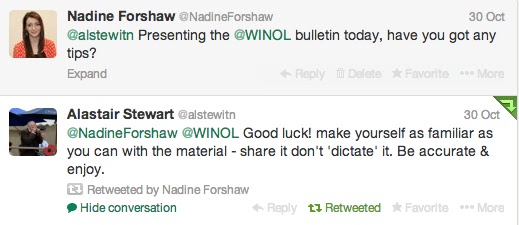
Chris Coneybeer also gave me advice on my Diane James interview, which we promoted and showed a small clip of in the bulletin. My questions were good, but Diane, like most politicians, was well trained and often managed to avoid the point I was focusing on. The interview would have benefited if I re-questioned her, even if it meant asking her the same thing several times, even if she never answers it, it makes it clear to the audience that this is a topic she is trying to avoid. Politicians will always say their party line and get across what they want to say, it is my job to push them further.
Wednesday, 30 October 2013
The Big Interview - Diane James
In a WINOL exclusive interview, UKIP’s
Diane James stated that other than its stance on Europe, the party is still
working on its policies regarding other issues.
Since February, MEP candidate, Tim Aker has
been developing the parties policies which will be announced “as and when it
suits” UKIP before the General Election in 2015.
When it comes to current issues such as
energy prices and economy, Diane stated that she is happy to sit back and watch
the larger parties “battle it out”.
The Waverly Councillor also expressed her disgust
against the Conservatives “illegal immigrants go home” posters calling them “abhorrent”,
and stated that if UKIP were successful in the General Election they would not
use such tactics.
Wednesday, 23 October 2013
WINOL - Week 4 - Vince Cable Energy Package
WINOL Week 4 -
On the Friday I managed to grab a quick interview with Business Secretary Vince Cable. I was pretty certain that I wouldn't be able to speak with him,as every other news organisation had booked a set slot with him, so I had the intention to grab some candid shots of him at the event and treat it similarly to my coverage of Nick Clegg. But as he walked away from the BBC my journalism training took over and I threw him a question regarding the energy price hikes, and thankfully he answered!
At Mondays news meeting Harry (this weeks News Editor) decided that we had to try and fit Vince Cable into the bulletin as he is a big name which would attract viewers, so I focused on turning it into a full package. My initial intention was to get a case study of an elderly resident to give the story a more local angle, however after knocking on many doors I eventually got the message that this was not going to happen.
As this was going to be a picture weak package I worked on making graphics to give it some more life. I also got in contact with British Gas to get their response to Vince Cables statement and they chose to send me a generic press release. Another tactic I chose to use to help get pictures for this story was "fair dealing" of a British Gas advertisement.
This weeks Guest Editor was Graham Bell. Angus Scott returned to WINOL aswell, so alongside Ian Anderson, we were spoiled for choice when it came to industry experts.
Graham Bell and Ian Anderson both said that my package was just missing one shot; Vince Cable arriving. His arrival would have provided me with the perfect set up shot so it was a real shame I didn't get it. Graham Bell used a Great British Bake Off analogy of Francis's picnic bake being "10 minutes away from perfection", my package was one shot away from perfection.
I had taken a lot of footage of Vince Cable throughout the day with the intention of using them for cutaways, however due to the colour difference between that and my interview footage, it wouldn't have made sense, so I chose to stick purely to the interview shot. My package also needed another shot to fill the time before the graphic, as it paused to white for an awkwardly long time. Graham Bell and Angus Scott were both quite pleased by my use of NAT SOT at the beginning and end of my package, which I was slightly worried was going to be bordering on cheesy.
Monday, 21 October 2013
Vince Cable slams energy companies over price hikes
Secretary of State for Business, Vince Cable, has slammed energy companies for blaming price hikes on green taxes.
Mr Cable told Winol: “There are green taxes and there are obligations on companies to help low income families with conservation but it’s not straightforward or honest to pretend that this is the cause of the big increase.”
British Gas has announced it will increase its prices by 9.2% from 23 November. They stated three reasons for the price hike; wholesale prices, improvements to pipes and wires, and the cost of complying with government programmes.
Vince Cable accepted that wholesale prices had played a big part in the increase.
But the Lib Dem minister said that energy companies were still not being transparent enough with customers.
Monday, 30 September 2013
The beginning of the end.
The first semester of our final year has kicked off. The second years are embracing their new roles and the third years are clinging on to what will be our final months on WINOL.
This semester I am taking the role of Political Editor and Radio Editor. As Political Editor I will be taking a step back from the weekly cycle on WINOL and try to reel in some bigger fish. So far I am feeling somewhat lost as my deadlines are now longer than a week but I'm sure I will soon get back into the swing of things. My first big interview I have set up is with UKIP member Diane James, who I'm sure all of you remember from the Eastleigh by-election. I will be reporting from Brooks Mews next Tuesday, when UKIP announce their candidates for the 2014 MEP elections. I will cover my interview with Diane James there also.
As Radio Editor I have already faced a few headaches and made the decision to cut our ties with the radio society. Unfortunately it came to the stage last semester where we couldn't depend on the existing radio station to even stream online regularly which was damaging our credibility. However this gave us the opportunity to create something entirely new and exciting, our features podcast. By utilising the use of podcasts the features team can have another platform to promote their work. We will be creating a podcast every week which will function as the features equivalent of WINOL. It is still in its very early stages of development but the basic idea is that we have a presenter who will bring in members of the features team to discuss their work, whether it be a review, fashion tips, or travelling anecdotes, there will be a place for it all. This will all be recorded "as live". It will then be refined and edited in post production to make it pretty and flamboyant enough to go on the website at a set deadline, in the same way WINOL goes "live at five". This podcast will then live on the website homepage until the following Tuesday when it will be replaced by the next show.
This semester I am taking the role of Political Editor and Radio Editor. As Political Editor I will be taking a step back from the weekly cycle on WINOL and try to reel in some bigger fish. So far I am feeling somewhat lost as my deadlines are now longer than a week but I'm sure I will soon get back into the swing of things. My first big interview I have set up is with UKIP member Diane James, who I'm sure all of you remember from the Eastleigh by-election. I will be reporting from Brooks Mews next Tuesday, when UKIP announce their candidates for the 2014 MEP elections. I will cover my interview with Diane James there also.
As Radio Editor I have already faced a few headaches and made the decision to cut our ties with the radio society. Unfortunately it came to the stage last semester where we couldn't depend on the existing radio station to even stream online regularly which was damaging our credibility. However this gave us the opportunity to create something entirely new and exciting, our features podcast. By utilising the use of podcasts the features team can have another platform to promote their work. We will be creating a podcast every week which will function as the features equivalent of WINOL. It is still in its very early stages of development but the basic idea is that we have a presenter who will bring in members of the features team to discuss their work, whether it be a review, fashion tips, or travelling anecdotes, there will be a place for it all. This will all be recorded "as live". It will then be refined and edited in post production to make it pretty and flamboyant enough to go on the website at a set deadline, in the same way WINOL goes "live at five". This podcast will then live on the website homepage until the following Tuesday when it will be replaced by the next show.
Tuesday, 14 May 2013
SKY News Interview
At the count of the Eastleigh By-election, I was interviewed by SKY News on the election so far.
Sunday, 24 March 2013
WINOL - Week 9 - The Budget 2013
This week I went to Westminster to cover the 2013 Budget for WINOL. As the budget was released on the Wednesday this obviously made my deadline very tight as I had to get to Westminster, film, get an interview with MP Mike Thornton, and get back in time to edit my package for WINOL at four. It was a fantastic experience if a little bit stressful, but one I would definitely be keen to re-live.
My Package:
Extended Interview with MP Mike Thornton:
Monday, 11 March 2013
WINOL - Week 6 - Eastleigh By- Election
The Eastleigh by-election was triggered by the resignation of Eastleigh MP Chris Huhne after he pleaded guilty to perverting the course of justice.
Fourteen parties took part in the race for the MP seat:
Party - Candidate
Liberal Democrat - Mike Thornton
Conservative - Maria Hutchings
Labour - John O'Farrell
UKIP - Diane James
Independent - Danny Stupple
Monster Raving Loony Party - Howling Laud Hope
Elvis Loves Pets - David Bishop
National Health Action Party - Dr Iain Maclennan
Beer, Baccy and Crumpet Party - Ray Hall
Christian Party - Kevin Milburn
Peace Party - Jim Duggan
English Democrats - Michael Walters
Trade Unionists and Socialists Against Cuts - Daz Procter
Wessex Regionalist - Colin Bex
However, despite the many parties in the race, the main contenders were the Lib Dems, Conservatives, Labour and UKIP. Eastleigh had been a Lib Dem constituency since 1994, but after the Huhne scandal they had their work cut out to regain the trust of the voters. Prior to 1994 the Eastleigh seat was held by the Conservatives, so the Conservatives were keen to reclaim Eastleigh, making this a real battle between the co-alition partners and threw Eastleigh into the media spotlight. For Labour the by-election was a chance to bring their party policies south as they are typically a party more popular in the northern parts of England, and they were pushing for Ed Milibands "one nation" Labour. UKIP saw this as their opportunity to be taken seriously, as a relatively new party this was their chance to compete against the three big parties and get their policies heard.
As part of their campaign all of the parties brought out the biggest names they could to help appeal to the voters. The Lib Dems brought Nick Clegg, the Conservatives brought David Cameron, UKIP brought Nigel Farage and Labour brought Ed Miliband.
The Conservatives came under some criticism that their candidate, Maria Hutchings, was not in the media light enough and wasn't interacting with the voters. This was something I found to be true as WINOL had a real struggle trying to get in touch with her prior to the election. I managed to interview her at one in the morning, after sitting through what can only be described as the longest housing meeting ever. However she only agreed to the interview out of sympathy for our student dedication and we were warned to only ask her about the housing development. On reflection I should have just asked her about her policies anyway, what were they going to do?
WINOL produced "The South Decides" on the night which was our Eastleigh by-election special. Our show went live at 10pm until 12pm and then it transferred to the radio show until about 1am when the show went live again as the results show.
For the by-election special I produced a package on housing and I was also the political correspondent reporting from the count in Eastleigh.
Housing package:
http://www.youtube.com/watch?v=n2K2K8KNfcU
The OB Team:
Louis, Kirsty, Ellen and myself.
Unfortunately on the night things didn't go quite as smoothly as we would have hoped. Producing live OB's from the count was optimistic but we felt that we were prepared. Originally we planned to link a camera and gun mic to a laptop and use Skype, however we soon learnt that we couldn't get the laptop to register both so we decided to compromise on the visual quality by using a web cam and the gun mic. We tested this system in the news room and it worked perfectly without any hiccups so we were sure it would be fine on the night, we had even practised with the exact equipment we would be using. What could go wrong? ... Everything.
We were the first of the media to arrive at the count, despite one lone BBC camera man and his never ending collection of wires. We decided to set up immediately and make sure everything worked. It didn't. At first we couldn't get the microphone to connect to the laptop so when we tested Skype Nicole couldn't hear anything. We tested all of the equipment and it worked separately, but refused to work together. We believed the source of the problem was the wire which connected the gun mic to the USB port so Lou ran to go and buy another. Once he returned we attempted Skype again and this time the laptop wouldn't recognise the web cam. By this point time was running out and we had been forced to move from our set up point as we were in the BBCs allocated space.
After many failed attempts our only workable solution was to Skype via iPhone... professional. But we made the best of a bad situation and gave live OBs whenever we were thrown to. We also managed to announce the result, although it didn't go as smoothly as production probably would have liked. We were unsure when the results would be announced so we were dependent on rumours and guess work. When Mike Thornton was announced as the winner of the Eastleigh by-election he was greeted with a cheer and a chorus of "we like Mike". We filmed the candidates giving their speeches and we managed to get reaction interviews with all of the candidates except for Maria Hutchings who refused all media interviews.
There was a fantastic atmosphere within the count, the hustle and bustle, grabbing people for interviews, trying to get as much information as we could from people, and being a part of the media scrum. The pressure of speaking on a live OB is the scariest thing I have done and the pressure was like no other. Fighting through the sheer exhaustion and running off of nothing but caffeine really gave us the feeling of being real journalists.
I was also lucky enough to be interviewed by Sky. I expected them to ask me about WINOL or our journalism course but no, they asked me about the election and the parties policies. Fortunately I had been following the by-election religiously so I could answer their questions, but it was unbelievable terrifying. I am currently badgering them to send me the footage, so I will upload it as soon as I get it.
All in all the by-election was a fantastic experience for us and provided fantastic material for us to report on. We were incredibly lucky that it was right on our doorstep, but I don't think I will be rushing to Eastleigh again anytime soon.
An edited version of the South Decides:
Fourteen parties took part in the race for the MP seat:
Party - Candidate
Liberal Democrat - Mike Thornton
Conservative - Maria Hutchings
Labour - John O'Farrell
UKIP - Diane James
Independent - Danny Stupple
Monster Raving Loony Party - Howling Laud Hope
Elvis Loves Pets - David Bishop
National Health Action Party - Dr Iain Maclennan
Beer, Baccy and Crumpet Party - Ray Hall
Christian Party - Kevin Milburn
Peace Party - Jim Duggan
English Democrats - Michael Walters
Trade Unionists and Socialists Against Cuts - Daz Procter
Wessex Regionalist - Colin Bex
However, despite the many parties in the race, the main contenders were the Lib Dems, Conservatives, Labour and UKIP. Eastleigh had been a Lib Dem constituency since 1994, but after the Huhne scandal they had their work cut out to regain the trust of the voters. Prior to 1994 the Eastleigh seat was held by the Conservatives, so the Conservatives were keen to reclaim Eastleigh, making this a real battle between the co-alition partners and threw Eastleigh into the media spotlight. For Labour the by-election was a chance to bring their party policies south as they are typically a party more popular in the northern parts of England, and they were pushing for Ed Milibands "one nation" Labour. UKIP saw this as their opportunity to be taken seriously, as a relatively new party this was their chance to compete against the three big parties and get their policies heard.
As part of their campaign all of the parties brought out the biggest names they could to help appeal to the voters. The Lib Dems brought Nick Clegg, the Conservatives brought David Cameron, UKIP brought Nigel Farage and Labour brought Ed Miliband.
The Conservatives came under some criticism that their candidate, Maria Hutchings, was not in the media light enough and wasn't interacting with the voters. This was something I found to be true as WINOL had a real struggle trying to get in touch with her prior to the election. I managed to interview her at one in the morning, after sitting through what can only be described as the longest housing meeting ever. However she only agreed to the interview out of sympathy for our student dedication and we were warned to only ask her about the housing development. On reflection I should have just asked her about her policies anyway, what were they going to do?
WINOL produced "The South Decides" on the night which was our Eastleigh by-election special. Our show went live at 10pm until 12pm and then it transferred to the radio show until about 1am when the show went live again as the results show.
For the by-election special I produced a package on housing and I was also the political correspondent reporting from the count in Eastleigh.
Housing package:
http://www.youtube.com/watch?v=n2K2K8KNfcU
The OB Team:
Louis, Kirsty, Ellen and myself.
Unfortunately on the night things didn't go quite as smoothly as we would have hoped. Producing live OB's from the count was optimistic but we felt that we were prepared. Originally we planned to link a camera and gun mic to a laptop and use Skype, however we soon learnt that we couldn't get the laptop to register both so we decided to compromise on the visual quality by using a web cam and the gun mic. We tested this system in the news room and it worked perfectly without any hiccups so we were sure it would be fine on the night, we had even practised with the exact equipment we would be using. What could go wrong? ... Everything.
We were the first of the media to arrive at the count, despite one lone BBC camera man and his never ending collection of wires. We decided to set up immediately and make sure everything worked. It didn't. At first we couldn't get the microphone to connect to the laptop so when we tested Skype Nicole couldn't hear anything. We tested all of the equipment and it worked separately, but refused to work together. We believed the source of the problem was the wire which connected the gun mic to the USB port so Lou ran to go and buy another. Once he returned we attempted Skype again and this time the laptop wouldn't recognise the web cam. By this point time was running out and we had been forced to move from our set up point as we were in the BBCs allocated space.
After many failed attempts our only workable solution was to Skype via iPhone... professional. But we made the best of a bad situation and gave live OBs whenever we were thrown to. We also managed to announce the result, although it didn't go as smoothly as production probably would have liked. We were unsure when the results would be announced so we were dependent on rumours and guess work. When Mike Thornton was announced as the winner of the Eastleigh by-election he was greeted with a cheer and a chorus of "we like Mike". We filmed the candidates giving their speeches and we managed to get reaction interviews with all of the candidates except for Maria Hutchings who refused all media interviews.
There was a fantastic atmosphere within the count, the hustle and bustle, grabbing people for interviews, trying to get as much information as we could from people, and being a part of the media scrum. The pressure of speaking on a live OB is the scariest thing I have done and the pressure was like no other. Fighting through the sheer exhaustion and running off of nothing but caffeine really gave us the feeling of being real journalists.
I was also lucky enough to be interviewed by Sky. I expected them to ask me about WINOL or our journalism course but no, they asked me about the election and the parties policies. Fortunately I had been following the by-election religiously so I could answer their questions, but it was unbelievable terrifying. I am currently badgering them to send me the footage, so I will upload it as soon as I get it.
All in all the by-election was a fantastic experience for us and provided fantastic material for us to report on. We were incredibly lucky that it was right on our doorstep, but I don't think I will be rushing to Eastleigh again anytime soon.
An edited version of the South Decides:
Wednesday, 20 February 2013
WINOL - Week 5 - Botley Housing Development
Written Story:
Eastleigh borough Council have given a large scale housing development the green light. The development will see one thousand four hundred new homes being built on farm land and a golf course near Botley. The green belt development will also include a primary school and significant road changes.
Eastleigh borough Council have given a large scale housing development the green light. The development will see one thousand four hundred new homes being built on farm land and a golf course near Botley. The green belt development will also include a primary school and significant road changes.
Hundreds of people turned up on Monday to hear the verdict
on the proposed Boorley Green housing plans. The meeting continued until
12:45pm and many residents were very disappointed when the council announced
that the plans had been approved.
The controversial decision has become a key issue in the
Eastleigh by-election. The Tory candidate, Maria Hutchings, says that she is
disappointed and the council has made the wrong decision.
However the Liberal Democrats, who back the plans, think they
will gain the respect of the voters as they make the hard decisions and
criticised Maria Hutchings for not speaking up during the meeting.
Video Report:
Extended Maria Hutchings - Conservative - Interview:
WINOL - Week 4 - Nick Clegg and Nigel Farage
As political reporter for WINOL I will be following the Eastleigh by-election over the next couple of weeks. This week was a highlight for me on WINOL as I was fortunate enough to be able to film Nick Clegg. Lou and I went to film with the vague hope of our own interview but unfortunately our dreams were too big! However I managed to get some fantastic footage.
On the saturday i got up early so I could film the first stage of the UKIP campaign and go an interview with Nigel Farage. Monday I filmed Nick Clegg and on Tuesday I went back to the UKIP campaign as they officially announced their candidate. I managed to get an interview with their candidate Diane James which I use in my package and I also turned into an extended feature interview for WINOL.
Video Report:
Extended Interview with Diane James:
On the saturday i got up early so I could film the first stage of the UKIP campaign and go an interview with Nigel Farage. Monday I filmed Nick Clegg and on Tuesday I went back to the UKIP campaign as they officially announced their candidate. I managed to get an interview with their candidate Diane James which I use in my package and I also turned into an extended feature interview for WINOL.
Video Report:
Extended Interview with Diane James:
Wednesday, 13 February 2013
WINOL - Week 3 - Chris Huhne
WINOL week three I covered the Chris Huhne scandal. The footage for this piece was made up of archive footage, newspaper headline shots, interview, vox pops and my piece to camera. My main issue with this story was finding enough images to hold it all together, as it is a national story and I was unable to get any footage of Chris Huhnes resignation statement.
On the Tuesday I went to Eastleigh to interview Keith House (Lib-Dem) and Ray Finch (UKIP) and to also gather vox pops from residents. Unfortunately, due to technical problems with the camera and sound I was unable to use any of the vox pops I had gathered, or my piece to camera, or my interview with Ray Finch. I then went back to Eastleigh on Wednesday morning to re-do my piece to camera and the vox pops from the public.
After a very stressful morning of filming and editing, I managed to turn it around in time for the bulletin.
Written Story:
On the Tuesday I went to Eastleigh to interview Keith House (Lib-Dem) and Ray Finch (UKIP) and to also gather vox pops from residents. Unfortunately, due to technical problems with the camera and sound I was unable to use any of the vox pops I had gathered, or my piece to camera, or my interview with Ray Finch. I then went back to Eastleigh on Wednesday morning to re-do my piece to camera and the vox pops from the public.
After a very stressful morning of filming and editing, I managed to turn it around in time for the bulletin.
Written Story:
Chris Huhne has resigned as the MP for Eastleigh after pleading guilty to perverting the course of justice.
Allegations first surfaced in 2010 that Huhne had got his then wife, Vicky Pryce, to take speeding points for him. The Eastleigh MP and his family consistently denied the allegations.
Huhne’s marriage later ended after he had an affair with his PR adviser, Carina Trimingham. The turbulent relationships within his family were highlighted by texts from his son, which were revealed in court.
His constituents showed very little sympathy for Huhne, one resident said: “I think he owes everyone in Eastleigh an apology”.
A by-election will now take place and with Huhne having won his seat with a near four thousand majority, the Lib Dems are confident they can maintain it. Councillor Keith House said: “it’s a great shame that the events that happened, happened, but we move on, go into the by-election confident that we can hold the seat and elect a new MP for our community”.
The date of the by-election is yet to be announced but there is speculation that it will take place in early May so it coincides with the local elections.
Video Report:
Sunday, 25 March 2012
Politics - Elections
Parliament can run for a maximum of five years – it needs to
be dissolved by the Queen before an election, and it can be dissolved at any
time. If the government no longer has the majority or they lose a vote of
confidence in the Commons then an election can be triggered. An example of this is Jim Callaghan, who lost
by one vote in 1979 (winter of discontent), he was then followed by Margaret
Thatcher. The coalition government has passed a law fixing the date of elections
every five years, the next occurring on May 7th 2015. Up until now
the Prime Minister fixed the date of elections. It has been a tradition to hold
them on a Thursday since 1935.
In order to vote you
have to be on the electoral register in your constituency. You’re not
automatically on the register even if you pay council tax. Around 45 million
people are on the electoral registers. Citizens overseas can vote, but less
than 15,000 of the estimated 5.5 million people actually do. There has been a
big rise in the number of postal votes, 15% of all votes cast in 2005 were
postal.
Who can’t vote?
·
Anyone under the age of eighteen.
·
Members of the House of Lords.
·
European Union citizens.
·
Citizens of any other country apart from the
Irish Republic and Commonwealth countries.
·
People serving a sentence in prison. (However
this is set to change)
Representation of the
People Act:
·
1918- Men over 21 and women over 30.
·
1928- Universal suffrage- all adults over 21.
·
1969- All adults over 18.
You have the right to vote but it is not compulsory.
You have the right to vote but it is not compulsory.
Who can stand in an
election?
Any citizen over eighteen.
Any citizen over eighteen.
How do you win?
First Past the Post – whoever gains a majority on the constituency is elected. This means that national voting percentages are not reflected in the number of seats. Therefore the election comes down to marginals because most votes in safe seats are wasted. Labour won half the seats in 2005 but only had 35% of the vote. This has led to people voting tactically, trying to stop the party they dislike most rather than voting for their first choice.
Each candidate must give a deposit of £500 which is returned if they get at least 5% of the votes cast. Spoilt ballots, such as ones with no markings or too many markings are disqualified. There will be a recount if the vote is very close.
First Past the Post – whoever gains a majority on the constituency is elected. This means that national voting percentages are not reflected in the number of seats. Therefore the election comes down to marginals because most votes in safe seats are wasted. Labour won half the seats in 2005 but only had 35% of the vote. This has led to people voting tactically, trying to stop the party they dislike most rather than voting for their first choice.
Each candidate must give a deposit of £500 which is returned if they get at least 5% of the votes cast. Spoilt ballots, such as ones with no markings or too many markings are disqualified. There will be a recount if the vote is very close.
Monday, 19 March 2012
Growth of Political Parties
The 19th century was a time of revolution. The “rotten
boroughs” changed the population and demographics in cities such as Liverpool
and Manchester. The Reform Act 1832 brought about a shift in representation for
the towns and the North. The repeal of the Corn Laws caused a massive change as
it was the end of the Tory Vs. Whig system and marked the beginning of the
Liberal and the Conservative Parties. The working class gained the vote in the
latter part of the 19th century due to electoral reform and a steady
increase of the reform acts.
Post First World War- Brought the rise of the Labour Party – The General Strike in 1926
Post Second World War- First Labour Government was established in 1945 with a secure majority. There were man social democratic reforms concerning the NHS, Keynesian Economics and Trade Union rights. This was also the point at which the British Empire began to decline.
William Beveridge promised national insurance from “cradle to grave” which was a golden moment for Labour. However disaster then followed in 1978-79 which the media labelled the “winter of discontent”. There were widespread strikes from many local authorities all demanding an increase in pay.
Post First World War- Brought the rise of the Labour Party – The General Strike in 1926
Post Second World War- First Labour Government was established in 1945 with a secure majority. There were man social democratic reforms concerning the NHS, Keynesian Economics and Trade Union rights. This was also the point at which the British Empire began to decline.
William Beveridge promised national insurance from “cradle to grave” which was a golden moment for Labour. However disaster then followed in 1978-79 which the media labelled the “winter of discontent”. There were widespread strikes from many local authorities all demanding an increase in pay.
Margaret Thatcher won the
General Election in 1979 and became Prime Minister. The miners strike was the
biggest confrontation between the unions and the Thatcher government- she was
committed to reducing the power of the trade unions, to cure the nation from
this “British disease”. The miners lost and returned to work in 1985. Unions
then changed drastically after realising the power of the state.
John Major then became Prime
Minister and leader of the Conservative Party in 1990. The mid 1990’s were a
boom period for tabloid journalism as the Tories got themselves involved with a
string of “sleaze scandals”. This proved to be too much for John Major who
resigned in 1995, to be re-elected as party leader.
Defence Minister, Jonathon
Aitken stated he would resolve the problem of twisted journalism with his “sword
of truth”. The Guardian reported that he was taking bribes, a claim which he
denied, however he was later convicted of perjury and perverting the course of
justice.
The rise of the “new” Labour
was seen as reformed leadership and Tony Blair was elected in 1997. His
government introduced the Human Rights Act and the Freedom of Information Act,
both of which are significantly important to journalists. Blair resigned in
2007 and Gordon Brown took over power. From 2010 to today we have a coalition government,
which is formed by Tory, David Cameron and Liberal Democrat, Nick Clegg.
Sunday, 11 March 2012
National Politics
Political Reporting is known as “The Fourth Estate” or the “watchdog”. The Legal Rights they hold are: Privilege and
Comment/ Free Expression (Article 10 of the Human Rights Act). Fair comment is
only a defence where the comment is supported by facts, is their honestly held
opinion, is a matter of public interest and is not malicious.
John Wilkes is an example of a hero journalist, he was forced into exile, he was the Mayor of London and an MP and he was elected from prison on three occasions. His private life was also notorious as he had numerous mistresses, partook in duels and was buried in debt. His publication “The North Briton” was anonymous and on one occasion he attacked (verbally) Lord Brute MP and King George the third, causing contempt of parliament. Wilkes established Statutory Qualified Privilege for reporting on parliament.
Westminster: The rules of privilege mean that you can report on virtually anything said in the House, however you must not forget the sub-judice rules such as contempt of court and you must avoid the taboo of mentioning the royals. Voting in the House of Commons is formally called a division. The parties will try and control the ways in which their MPs vote through whipping (they get the tough guys to persuade them) unless it is a matter of the conscience, for example abortion.
All new laws have to be approved by both Houses of Parliament, except for tax raising measures which are for the MPs alone to decide. Peers in the House of Lords are not elected and therefore do not represent constituencies, they are also not paid but they are allowed to claim expenses. Peers are not allowed to vote on changes to taxation or finance and they will never have the final word but they government may sometimes choose to compromise.
John Wilkes is an example of a hero journalist, he was forced into exile, he was the Mayor of London and an MP and he was elected from prison on three occasions. His private life was also notorious as he had numerous mistresses, partook in duels and was buried in debt. His publication “The North Briton” was anonymous and on one occasion he attacked (verbally) Lord Brute MP and King George the third, causing contempt of parliament. Wilkes established Statutory Qualified Privilege for reporting on parliament.
Westminster: The rules of privilege mean that you can report on virtually anything said in the House, however you must not forget the sub-judice rules such as contempt of court and you must avoid the taboo of mentioning the royals. Voting in the House of Commons is formally called a division. The parties will try and control the ways in which their MPs vote through whipping (they get the tough guys to persuade them) unless it is a matter of the conscience, for example abortion.
All new laws have to be approved by both Houses of Parliament, except for tax raising measures which are for the MPs alone to decide. Peers in the House of Lords are not elected and therefore do not represent constituencies, they are also not paid but they are allowed to claim expenses. Peers are not allowed to vote on changes to taxation or finance and they will never have the final word but they government may sometimes choose to compromise.
Hansard is the official report on the proceedings of
parliament and is published daily.
J'Accuse - The Dreyfus Affair
The defeat of France in the Franco –Prussian war in 1871 was
still casting a shadow by 1894, due to this France were very concerned about
anything which may have questioned France’s greatness. They were a very
militaristic country, the army was seen as a symbol of French identity, they
were worried about another war with Germany and there had been a large increase
in spying in Europe.
Evidence of secret information regarding the French military was found in a wastepaper basket in Germany. The Embassy and the army immediately implicated Captain Dreyfus. This was because he was well educated, from Alsace and primarily because he was Jewish. Dreyfus denied these claims however the army then held a secret court martial and found him guilty of treason. He was then stripped of his military rank and was sentenced to the “Devils Island” in 1894.
Evidence of secret information regarding the French military was found in a wastepaper basket in Germany. The Embassy and the army immediately implicated Captain Dreyfus. This was because he was well educated, from Alsace and primarily because he was Jewish. Dreyfus denied these claims however the army then held a secret court martial and found him guilty of treason. He was then stripped of his military rank and was sentenced to the “Devils Island” in 1894.
Later an officer looked into the evidence and discovered that
it was wrong and the culprit was actually a man called Esterhazy, however this
evidence was dismissed by his superiors.
Esterhazy was put on trial in a military court but he was acquitted.
The famous French journalist Emile Zola then decided to get involved
and wrote the famous article “J’Accuse”. However Zola was then tried and
convicted of libel and was fined and sentenced to prison, but then fled to
London. There were anti-Jewish riots all over France at this time, the right
wing papers were calling for Jews to lose their citizenship.
The army then began to recognise the weakness of the case
against Dreyfus and more documents were discovered to have been forged by an officer
called Henry. Dreyfus was brought back to court but was once again found to be
guilty, this time with “extenuating circumstances”.
Sunday, 12 February 2012
Public Affairs
Winchester is conservative and Steve Brine is the current MP, he represents Winchester in parliament but has no direct control in the local council. The MP has a clinic on Friday’s where you can address him and make complaints, but he has very little direct power.
There are two tiers of council power:
County Council
City Council/District Council
Parish Council/Town Forum
The most notable difference between a county and city council is their difference in budget, Hampshire country council controls a budget of £1.8 billion, whereas the Winchester city council only controls a budget of £12 million.
Big cities such as Southampton only have a 1 layer “unitary authority”.
Local authorities are funded by a combination of grants from central government, council tax and business rates. Council tax only provides about a quarter of the local funding.
Councillors are elected by local people for a four year term from a ward (area, like an MP gets elected from a constituency, a councillor will be elected from a ward). Councillors are responsible for making decisions on behalf of their local community about local services, such as land use and parking restrictions.
As a journalist you can report on council meetings as you have Qualified Privilege, but you must give a councillor the right to defend themselves if you are going to publish something defamatory.
There are two tiers of council power:
County Council
City Council/District Council
Parish Council/Town Forum
The most notable difference between a county and city council is their difference in budget, Hampshire country council controls a budget of £1.8 billion, whereas the Winchester city council only controls a budget of £12 million.
Big cities such as Southampton only have a 1 layer “unitary authority”.
Local authorities are funded by a combination of grants from central government, council tax and business rates. Council tax only provides about a quarter of the local funding.
Councillors are elected by local people for a four year term from a ward (area, like an MP gets elected from a constituency, a councillor will be elected from a ward). Councillors are responsible for making decisions on behalf of their local community about local services, such as land use and parking restrictions.
As a journalist you can report on council meetings as you have Qualified Privilege, but you must give a councillor the right to defend themselves if you are going to publish something defamatory.
Subscribe to:
Posts (Atom)